THE MACHINE ISN'T THE STORY. WE ARE.

Abhishek Gourav
Author

The future of AI in the legal industry will be decided by the people behind it — not the models.
I've sat through enough legal-tech panels now to notice a pattern. Someone puts up a slide with a hockey-stick graph, says the words “co-pilot” and “efficiency” in the same breath, and the room nods along like we've all agreed on something. We haven't. We've just agreed to stop asking the harder question, which is: efficient for whom, and answerable to whom?
That question is where I want to start, because I don't think the future of AI in law will be decided by which **model** wins. It will be decided by the people who choose to deploy it, the judgment they bring to that choice, and — more than either of those — their willingness to be held accountable for what the machine produces in their name.
The tool has never been the risk Every profession that has taken AI seriously has learned the same lesson at different speeds: the technology arrives neutral and leaves stamped with the values of whoever picked it up first. Law is no exception, except that law has less room for error than most fields, because its output isn't a draft blog post or a marketing email — it's someone's liberty, someone's company, someone's custody arrangement.
We already have the cautionary tales. Lawyers sanctioned for filing briefs with fabricated citations a language model invented with total confidence. Firms discovering, too late, that a contract-review tool trained on one jurisdiction's boilerplate quietly imported assumptions that don't hold in another. None of these were failures of the technology doing something unexpected. They were failures of a person deciding not to look closely enough at what the technology handed back.
That's the uncomfortable part. It's tempting to talk about AI adoption as a technical rollout — pick a vendor, run a pilot, measure the time saved. But every one of those steps is a human decision wearing a technical costume. Someone decided the pilot's success metric was speed rather than accuracy. Someone decided the review process for AI-drafted clauses could be lighter than the review process for human-drafted ones. Someone decided not to ask where the training data came from. The software didn't make those calls. A person did, usually under deadline pressure, usually with good intentions, and usually without quite realizing they'd made a judgment call at all.
What “the people behind it” actually means I don't mean this as a call for more ethics committees, though those have their place. I mean something narrower and more practical: the quality of AI's role in law will track, almost exactly, the seriousness of the individuals choosing where it's allowed to touch a legal outcome and where it isn't, it is for the firm to decide.
A firm led by someone who treats AI output the way they'd treat a first-year associate's draft — useful, sometimes sharp, never final without a second set of trained eyes — will end up somewhere very different from a firm led by someone who treats it as a shortcut past the associate altogether. Same technology. Different people. Different futures.
This is why I'm sceptical of conversations that frame AI adoption in law purely as a capability question — “can it draft, can it research, can it predict outcomes.” Increasingly, yes, it can do quite a lot of that, and it will keep improving. The capability question is close to solved. The judgment question is not, and it's not a question the technology can solve for us. It's a question about who we hire, how we train them, what we reward, and what we're willing to slow down for.
The uncomfortable incentive problem Here's the part I think gets skipped in most panel discussions: the economics of legal practice currently reward speed over scrutiny. Billable efficiency, faster turnaround, more matters per associate — these are the metrics that get a partner promoted. AI is extraordinarily good at feeding those metrics. It is not, on its own, good at feeding the metric that actually protects a client: someone caring enough to catch the error before it leaves the building.
So the real test of an organization's AI maturity isn't whether it has adopted the tools. It's whether it has changed its incentive structure to match. Has it built time into the workflow for verification, or has it just quietly absorbed the time AI saved into higher output targets? Has it trained junior lawyers to interrogate AI-generated work with the same skepticism they'd apply to a stranger's draft, or has it let them treat machine output as presumptively correct because it arrived formatted and confident? These are leadership decisions, not procurement decisions.
Where this leaves us I don't think the legal industry is heading toward a future where AI replaces judgment. I think it's heading toward a future that makes the presence or absence of good judgment far more visible, far faster, than it used to be. A careless lawyer with a word processor produced a bad contract slowly. A careless lawyer with an AI system produces many bad contracts quickly, and confidently, and at scale. The technology doesn't create the carelessness. It amplifies whatever was already there.
Which means the organizations that will define this next decade of legal practice won't be the ones with the most sophisticated AI stack. They'll be the ones whose people — from managing partner to first-year associate — treat every AI output as a starting proposition rather than a finished answer, and who've built a culture where saying “I don't trust this yet, let me check” is rewarded rather than seen as slowing things down.
The machine will keep getting better. That was never really in doubt. The open question — the one worth debating at every conference, in every boardroom, before every tool purchase — is whether the people using it are getting more careful at the same pace the tool is getting more capable. Right now, in most rooms I sit in, that race isn't close. The technology is winning it. That should trouble us more than it seems to.
Share this article
Written by
Abhishek Gourav
Abhishek Gourav is an entrepreneur and business leader with over 19 years of experience in business development, strategic growth, market positioning, and global relationship management. He is known for building high-value business platforms, creating scalable conference ecosystems, and turning ideas into commercially successful ventures with strong industry relevance. Currently, Abhishek is leading multiple ventures across conferences, media, business networking, and holistic wellness sectors: * Co-Founder & Director, ClickAway Creators Leads the strategic growth of flagship platforms including LexTalk World and EdTalk World, bringing together 3,000+ professionals, industry leaders, policymakers, innovators, and solution providers from the legal and education sectors across global markets. * CEO, MantraNex Vista Pvt. Ltd. | MysticVerse Global Oversees the company’s vision, business strategy, marketing direction, concept development, partnerships, and revenue planning. He is actively driving the expansion of LexTalk World APAC & Middle East along with MysticVerse Global, a platform focused on mysticism, holistic wellness, spiritual sciences, and conscious business experiences. With deep expertise in strategic partnerships, conference production, stakeholder engagement, and content-led business positioning, Abhishek focuses on building ventures that combine strong commercial value with long-term industry impact. His approach blends relationship-driven growth, market understanding, and execution discipline to deliver sustainable and scalable business outcomes.
Related Articles
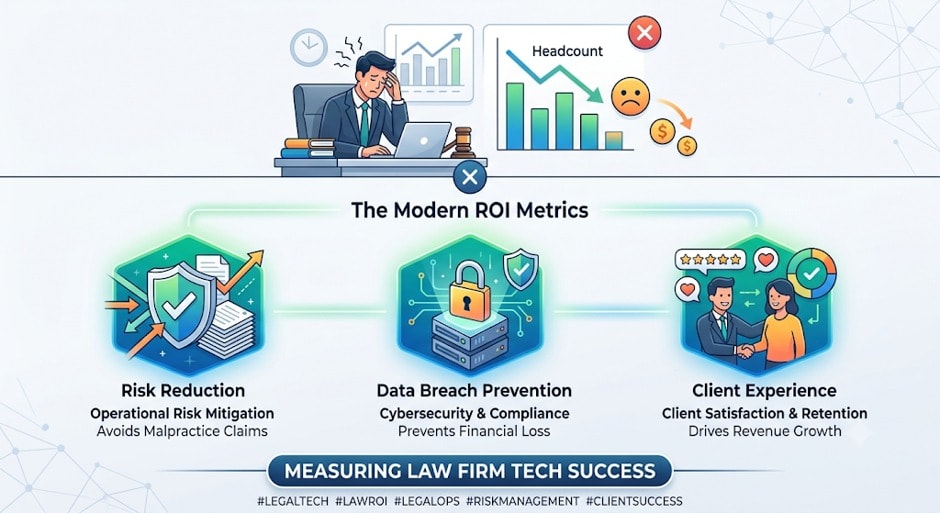
Reevaluating Law Firm Tech Success by Shifting Focus from Headcount Reduction to Risk Prevention and Client Experience Metrics

Judicial Enforcement Against AI Hallucinations in Legal Filings