Reevaluating Law Firm Tech Success by Shifting Focus from Headcount Reduction to Risk Prevention and Client Experience Metrics
Kaushik Karmakar
Author
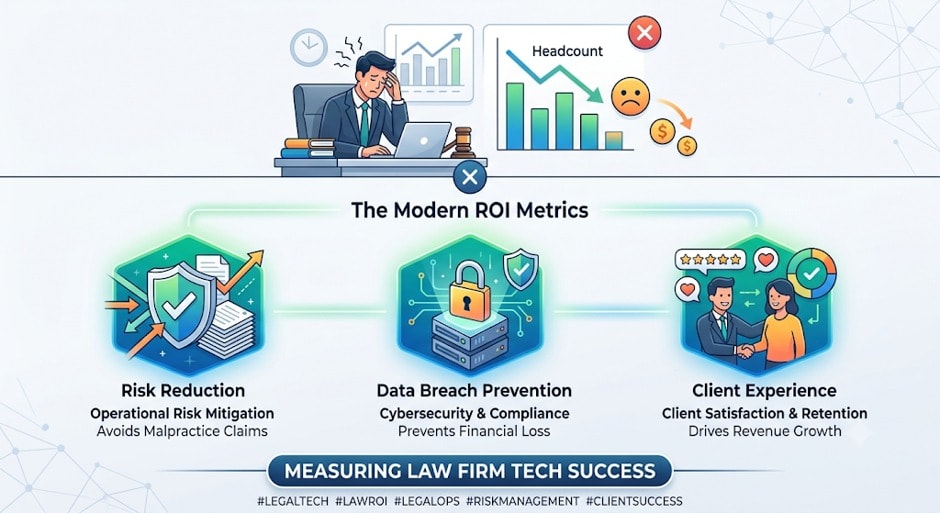
For decades, the standard formula for evaluating technology return on investment across commercial enterprises centred on a single, crude metric: headcount reduction. When corporate executives invested in enterprise software, they expected to lower labour overhead by automating repetitive tasks and trimming administrative staff. Within the legal sector, however, applying this corporate metric has proven fundamentally flawed. Law firms operate on business models deeply rooted in specialized human capital, professional reputation, and stringent duties of confidentiality. Attempting to justify legal technology investments primarily through payroll cuts ignores the core realities of modern practice and fails to capture where true operational value is generated.
In today's legal landscape, calculating technology success requires a comprehensive **framework** that prioritizes risk reduction, data breach prevention, and client experience enhancements. As law firms navigate heightened regulatory scrutiny, sophisticated cybersecurity threats, and evolving client expectations, the real return on investment lies not in replacing human legal talent, but in safeguarding firm assets and deepening client relationships.
The Flaw of Headcount Reduction in Legal Operations Relying on headcount reduction as the primary indicator of technology return on investment creates structural misalignment within a law firm. In traditional billable hour structures, reducing staff hours without a corresponding increase in matter volume or strategic capacity can inadvertently contract the firm's revenue base. Furthermore, legal work demands nuanced judgment, statutory interpretation, and ethical accountability that technology cannot replace.
When law firms implement document assembly, automated conflict checking, or legal analytics, the objective is rarely to eliminate personnel. Instead, technology elevates human capital by reallocating professional time from low-value routine tasks to high-value strategic counsel. Evaluating legal technology through the narrow lens of labour reduction obscures the substantial financial protection and competitive advantages that modern tools deliver.
Quantifying Return on Investment Through Data Breach Prevention Law firms have become prime targets for malicious threat actors due to the extraordinary concentration of sensitive client data they hold, including proprietary intellectual property, merger and acquisition strategies, financial statements, and privileged communications. A single security incident can jeopardize attorney-client privilege, trigger severe regulatory fines, and irreparably damage market reputation. Consequently, cybersecurity tools and secure document management systems generate immediate return on investment by preventing catastrophic financial loss.
Measuring the financial return of breach prevention technology involves evaluating avoided liabilities and operational continuity. Key metrics include:
Reduction in Exposure to Ransomware and Extortion Costs: Secure cloud architecture, endpoint detection, and robust multi-factor authentication systems protect firms from costly operational freezes and ransom demands.
Cyber Insurance Premium Optimization: Insurance carriers evaluate firm security posture rigorously. Implementing verified threat detection and encrypted document portals directly reduces annual insurance premiums and lowers policy deductibles.
Avoidance of Regulatory Penalties and Malpractice Claims: Data privacy frameworks such as the General Data Protection Regulation and state-specific privacy laws impose steep fines for non-compliance. Preventing data leaks protects the firm from statutory penalties and client-driven breach litigation.
When technology prevents a cyber incident that could cost millions of dollars in forensic remediation, business **disruption**, and lost retainers, the software pays for itself many times over.
Operational Risk Mitigation and Malpractice Avoidance Beyond cybersecurity, operational risk in legal practice stems from administrative oversights, human error, missed court deadlines, and unflagged conflicts of interest. Malpractice claims and ethical violations represent massive financial drains, involving legal defence costs, elevated insurance rates, and reputational harm.
Modern legal technology platforms serve as automated guardrails against these systemic risks. Evaluating technology success through operational risk reduction requires tracking specific compliance metrics:
Conflict Check Precision: Advanced relational database tools reduce the risk of taking on conflicting representations, eliminating ethical breaches and subsequent fee disgorgements.
Docketing and Deadline Accuracy: Automated calendar and docket management systems synchronize court rules directly into attorney schedules, drastically reducing missed filing deadlines, which remain a leading cause of legal malpractice claims.
Contract Review Standardisation: AI-assisted contract review tools audit documents against firm-approved clause libraries, minimizing human oversight in complex commercial agreements and reducing liability exposure.
By converting unpredictable human error into standardized, audited workflows, legal technology delivers measurable financial value through risk containment.
Transforming Client Experience into Revenue Retention The third pillar of legal technology return on investment resides in client experience metrics. In a highly competitive legal marketplace, corporate clients increasingly demand real-time visibility, predictable billing, and frictionless communication. Technology that transforms the client journey directly impacts client retention, matter expansion, and lifetime client value.
Law firms can quantify technology success through key client-centric performance indicators:
Client Retention and Net Promoter Scores: Secure client portals that offer transparent billing updates and immediate document access improve client satisfaction scores, leading to higher institutional retention rates.
Speed to Resolution and Matter Efficiency: Streamlined communication platforms and automated discovery tools reduce cycle times for corporate transactions and litigation, allowing clients to achieve business objectives faster.
Expanded Share of Wallet: Clients who experience seamless, tech-enabled service delivery are far more likely to consolidate their legal spend with a single trusted firm across multiple practice groups.
Rather than viewing client service software as an overhead expense, forward-thinking firms recognize it as a primary driver of organic revenue growth and fee realization.
Establishing a Modern Legal Technology Metrics **Framework** To accurately assess technology success, law firm leadership must move away from retrospective financial reviews and adopt a balanced scorecard **approach**. This **framework** combines risk management metrics, security performance indicators, and client satisfaction data alongside standard financial reporting.
Operational Metric Category Key Performance Indicator Strategic ROI Impact Cybersecurity and Compliance Incidents blocked, audit score improvements, cyber insurance premium savings Avoidance of regulatory fines, litigation defence costs, and reputational damage Operational Risk Management Zero missed court deadlines, conflict resolution speed, reduced drafting error rates Prevention of malpractice claims and reduction in unbillable rework Client Experience Client portal adoption rate, Net Promoter Score, response time reduction Increased client retention rates and expansion of matter instructions Strategic Capacity Percentage of partner time shifted to higher-value advisory work Higher billing realization rates and improved margin per matter Reframing Success for the Modern Law Firm Evaluating technology success in the legal industry requires a fundamental mindset shift. The true measure of a successful technology implementation is not how many positions a firm can eliminate, but how effectively the firm fortifies its operations against risk, protects confidential client information, and delivers superior legal service.
When law firms measure return on investment through data breach prevention, operational risk reduction, and elevated client experience, they gain an accurate understanding of software value. In doing so, they build a resilient, client-focused practice capable of thriving in an increasingly digital world.
Share this article
Written by
Kaushik Karmakar
A legal industry expert and contributor to LexTalk World, sharing insights on global legal developments, technology, and professional growth.