India's DPDP Act and the New Grammar of Global Data Compliance
Kaushik Karmakar
Author
The Border Within the Border
How one of the world's largest digital economies is rewriting the rules of cross-border data flows — and what it means for businesses navigating a fragmented regulatory landscape
Data has no passport. It moves at the speed of light, indifferent to jurisdictions, trade treaties, or national flags. Yet 2025 and 2026 have made one thing unmistakably clear: governments are determined to give it one. At the centre of this global reckoning stands India — home to over a billion internet users — whose landmark Digital Personal Data Protection Act (DPDP Act), 2023, operationalised through DPDP Rules notified in November 2025, is now reshaping how corporations think about privacy compliance, transaction structuring, and international data **strategy**.
From Principles to Practice: The DPDP Rules Arrive
The DPDP Act received Presidential assent in August 2023, but its teeth only emerged when the Ministry of Electronics and Information Technology (MeitY) formally notified the DPDP Rules, 2025 on November 13, 2025. These Rules transform the Act's broad principles into binding, operational mandates. The **framework** is now real — and the clock is ticking.
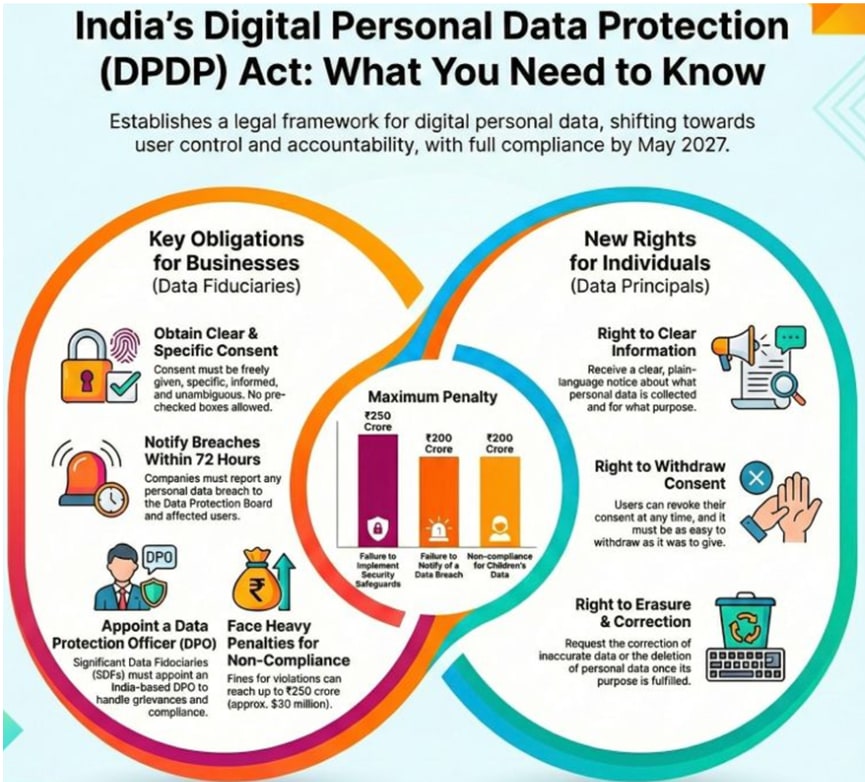
Compliance is structured in phases, with full implementation required by mid-May 2027. For corporates, this means three simultaneous workstreams: first, standing up consent management infrastructure; second, appointing Data Protection Officers (for entities classified as Significant Data Fiduciaries, or SDFs); and third, implementing breach notification pipelines. Penalties are not symbolic — non-compliance can attract fines of up to ₹250 crore (approximately USD 30 million) for failure to implement reasonable security safeguards.
The compliance burden is substantial. Multinationals processing Indian personal data must redesign global data flows, renegotiate vendor contracts, update privacy notices, and create verifiable consent mechanisms — all while the Data Protection Board of India is being constituted. Large enterprises, particularly in fintech, SaaS, and healthcare, are finding that DPDP compliance is not a legal checkbox but an operational **transformation**.
The "Negative List" Revolution: A Departure from Global Norms
Perhaps the most consequential — and globally distinctive — feature of India's **framework** concerns cross-border data transfers. Earlier drafts flirted with strict data localisation and GDPR-style "whitelist" adequacy models. The final architecture took a sharper turn.
Under Rule 15 of the DPDP Rules, a Data Fiduciary may transfer personal data outside India to any jurisdiction — unless the Central Government explicitly restricts that destination by notification. This is the "negative list" or blacklist **model**: the default is permissive, not prohibitive. This inverts the EU's adequacy logic, where transfers are restricted unless the recipient country is formally approved.
The shift offers breathing room for Indian startups, cloud-native businesses, and multinationals managing global operations. But it introduces a structural uncertainty that compliance teams find uncomfortable: the government retains broad, discretionary authority to restrict transfers — without prescribed criteria, advance notice, or mandatory alternative mechanisms. Geopolitical considerations, sector sensitivities, or national security calculations could trigger restrictions overnight. As of mid-2026, the negative list has not yet been published — but when it arrives, its contours will rewrite data strategies for hundreds of multinational corporations.
Sectoral complexity compounds this. Regulators such as RBI, SEBI, and IRDAI maintain separate localisation mandates for financial and insurance data, creating a layered compliance landscape where DPDP Rules interact with — and do not override — domain-specific rules. A fintech firm, for instance, must simultaneously satisfy DPDP's permissive transfer baseline and RBI's stricter storage requirements for payment data.
Data Sovereignty vs. Global Commerce: The Geopolitics of Compliance
India's evolving **framework** does not exist in isolation. Across the Indo-Pacific and MENA regions, data governance is fragmenting rapidly — posing significant challenges for businesses operating across fluid borders.
ASEAN has pursued regional harmonisation through the ASEAN Data Management **Framework** and a Cross-Border Data Flows Mechanism, but the bloc's regulatory variance remains wide — from Singapore's advanced PDPA amendments (effective mid-2025) to nascent frameworks elsewhere in the region. Singapore, in particular, is emerging as a bridge jurisdiction: its adequacy recognitions, bilateral MoUs (including with India), and compliance infrastructure make it a strategic hub for companies routing data across South and Southeast Asia.
In MENA, Gulf states are accelerating data localisation laws driven by sovereignty concerns and emerging AI governance priorities. The UAE's PDPL and Saudi Arabia's PDPL impose stringent residency requirements for certain categories of personal data, creating direct friction for businesses managing unified cloud infrastructures across India, the Gulf, and Europe.
The EU-India axis adds further complexity. GDPR requires that data transferred to India meet adequacy standards — yet India lacks a formal adequacy determination from Brussels. Companies bridging these jurisdictions must still rely on Standard Contractual Clauses and binding corporate rules, even as India's own **framework** matures.
Compliance as **Strategy**, Not Just Risk Management
For corporate counsels and transaction teams, the message is clear: data compliance has become a deal-critical variable. In M&A due diligence, acquirers now scrutinise target companies' data inventories, cross-border transfer mechanisms, and DPDP readiness as part of standard legal risk assessment. In technology transactions and outsourcing arrangements, data processing agreements must now reflect India's Rules alongside GDPR, PDPA, and MENA equivalents — requiring genuinely multi-jurisdictional drafting.
The deeper strategic **insight** is this: data sovereignty and global commerce are not irreconcilable — but bridging them requires deliberate architecture. Organisations that invest in privacy-by-design infrastructure, interoperable consent management, and modular data flow governance are transforming compliance from a cost centre into a competitive asset. In an era where trust is a measurable business metric, that investment pays.
India's DPDP **framework**, now fully activated, is not merely a domestic regulatory event. It is a signal — one of the clearest yet — that the era of frictionless global data movement is giving way to a more negotiated, sovereignty-conscious, and ultimately more accountable digital order. Businesses that read this signal early will shape that order. Those that don't will merely be shaped by it.
The DPDP Rules 2025 are subject to phased enforcement through May 2027. Significant Data Fiduciary classifications and the negative-list of restricted transfer destinations remain to be formally notified by the Central Government.
Source of photo
https://i0.wp.com/eastmojo.com/wp-content/uploads/2026/05/DPDPA.png?fit=1536%2C1024&ssl=1
Share this article
Written by
Kaushik Karmakar
A legal industry expert and contributor to LexTalk World, sharing insights on global legal developments, technology, and professional growth.