The Proposed 2026 FCRA Bill Radically Alters Legal Frameworks for Indian Nonprofits and Foreign Donors
Kaushik Karmakar
Author
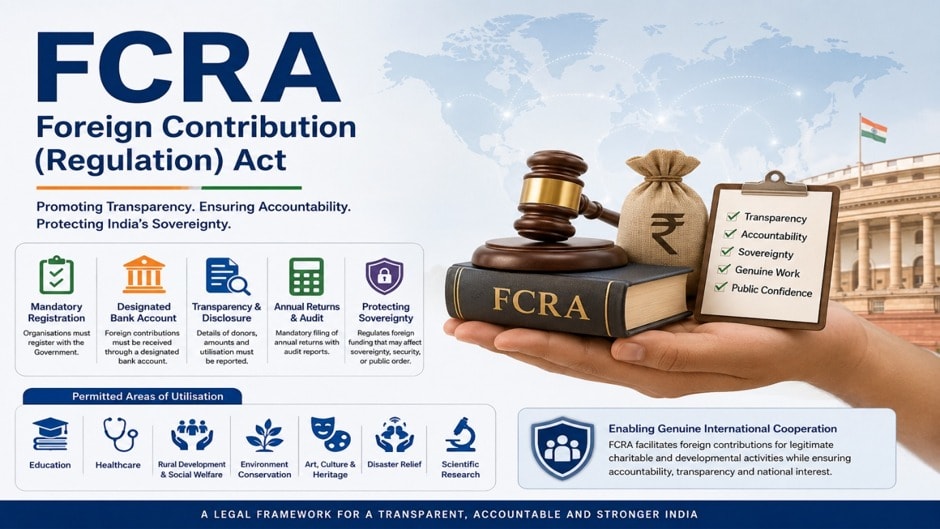
The Foreign Contribution Regulation Act has been the primary framework governing how non-profit organizations in India receive and utilize foreign funds. The proposed Foreign Contribution Regulation Act Amendment Bill of 2026 marks a structural shift in this regulatory architecture. It is imperative to comprehend the historical context, the present relevance, the specific rationale of the government, and the exact legal and penal implications for both local recipients and international donors.
History of the Act India originally enacted the Foreign Contribution Regulation Act in 1976 to prevent foreign interference in domestic politics and internal affairs. In 1984, an amendment made it mandatory for all non-governmental organizations receiving foreign funds to register officially with the Ministry of Home Affairs. A completely overhauled version was passed in 2010 to strengthen compliance mechanisms and track the receipt of foreign money more effectively. The 2010 legislation introduced Section 15, which stipulated that assets created out of foreign contributions would vest in a prescribed state government authority if an organization had its registration cancelled.
Subsequent amendments progressively tightened the compliance parameters. The 2020 amendment mandated that all foreign contributions must be received exclusively in a designated bank account at the State Bank of India main branch in New Delhi, capped administrative expenses at 20 percent of the total foreign funds received, and strictly prohibited transferring foreign funds from one registered non-profit to another unregistered or registered entity. These rolling changes effectively centralized administrative control over the non-profit sector.
Relevance Now The relevance of the Foreign Contribution Regulation Act has intensified heavily in the present decade due to the unprecedented scale of administrative cancellations. Over the past ten years, nearly 22,000 non-governmental organization registrations have been cancelled, and around 15,000 have been deemed to have ceased upon the expiry of their validity periods. Consequently, foreign contributions and physical assets worth thousands of crores of rupees have been left in a state of legal ambiguity. The 2010 provision empowering state governments to take over these assets proved functionally ineffective, as states lacked the administrative capacity to seize, maintain, or manage them. The introduction of the 2026 Amendment Bill directly addresses this administrative failure and restructures the asset management protocol.
Reasons the Indian Government is Passing the Bill The primary legislative intent behind the 2026 Bill is to resolve the operational gaps in managing the assets of organizations that no longer hold a valid registration. By proposing the deletion of Section 15 and inserting a new Chapter IIIA, the government seeks to establish a central Designated Authority. This central authority will oversee the vesting, management, and disposal of foreign contributions and assets of non-profits whose certificates have been cancelled, surrendered, or have ceased to exist.
The government aims to ensure that funds intended for public or charitable purposes are not locked up indefinitely or misused when an organization loses its legal right to operate. The designated authority will act as a custodian that can either return the assets if the registration is successfully restored or liquidate them for public purposes, depositing the monetary proceeds directly into the Consolidated Fund of India. The government maintains that this system will prevent foreign assets from being misappropriated while bringing absolute transparency and closure to the cancellation process.
Data on foreign funding to Indian organizations. Source: Business Standard / Tracing the broad spectrum of NGO foreign funding ecosphere in ...
Legal Implications for Indian Non-Profit Organizations For Indian non-profit organizations, the legal implications of the 2026 Amendment Bill are severe.
First, the concept of provisional vesting is introduced. Under Section 16A of the proposed bill, all foreign contributions and the assets created from them will provisionally vest in the Designated Authority from the exact date a registration is cancelled, surrendered, or ceases to exist. The organization will immediately lose management control over its own foreign-funded assets.
Second, the bill provides absolute clarity that registration automatically ceases on the date of expiry if a renewal application is not submitted or if the government denies the renewal. There is no legal grace period. If the organization cannot restore its registration within a prescribed timeframe, the provisional vesting legally converts into permanent vesting. This implies that an organization cannot choose to exit the framework voluntarily without permanently forfeiting all assets created through foreign funds. To retain these assets, an organization is legally coerced to renew its registration perpetually.
Third, judicial intervention is heavily restricted. The bill bars civil courts or tribunals from ordering the attachment, seizure, or sale of any property vested in the Authority, except as strictly provided under the Act. Affected organizations have the legal remedy of seeking a revision from the Authority within 90 days, with a subsequent right of appeal before a District Judge. However, there is no explicit opportunity to be heard prior to the government denying a renewal application.
Legal Implications for Overseas Donors The legal landscape for overseas donors becomes incredibly precarious under the new provisions. The strict prohibition on sub-granting established in 2020 already means that foreign donors cannot rely on intermediary organizations to distribute funds locally. With the 2026 Bill, overseas donors face the direct risk that their granted funds and the physical assets created from those funds could be permanently seized by the Indian government.
Foreign donors must conduct exhaustive legal due diligence before disbursing funds. A mere delay by the local partner in filing for registration renewal could lead to the cessation of their certificate, instantly transferring control of the donor funded project to the Designated Authority. Donors will need to insert stringent compliance covenants in their grant agreements, specifically mandating early renewal filings and continuous tracking of fund utilization to mitigate the risk of sudden asset forfeiture.
Implications on Violation from the Legal Aspect The legal framework concerning violations features a dual approach under the proposed 2026 Bill.
On the administrative side, the penalties for non-compliance, such as failing to renew on time or violating usage conditions, result in the absolute loss of property through the vesting mechanism. The Act creates a strict liability environment where even inadvertent procedural delays will trigger total asset forfeiture. Furthermore, the bill explicitly prohibits any key functionary of the penalized organization from indirectly or directly acquiring any interest in the disposed assets, preventing any legal circumvention by the original operators.
On the criminal side, the 2026 Amendment Bill introduces a reduction in the maximum penal sentencing. It proposes reducing the maximum imprisonment for violations of the Act from five years to one year. While this appears as a relaxation of criminal liability, it is strategically counterbalanced by the severe administrative penalty of asset confiscation. The reduction in the prison sentence may streamline the prosecution process for the state, making it faster to secure convictions for minor violations without enduring lengthy trials, while the real deterrent remains the permanent loss of organizational assets.
The legal environment finalized by this proposed bill places the burden of flawless compliance entirely on the organizations and demands continuous oversight by international donors.
Share this article
Written by
Kaushik Karmakar
A legal industry expert and contributor to LexTalk World, sharing insights on global legal developments, technology, and professional growth.
Related Articles
CIIRP and the Evolution of India’s Insolvency Framework Under the IBC Amendment Bill 2025
Unlocking Private Equity and Venture Capital Growth Across Japan India and Middle East