Modernizing Legal Operations by Integrating Generative AI with Strategy and Risk Management

Kaushik Karmakar
Author
The corporate legal sector stands at an unprecedented inflection point. For decades, the legal delivery ecosystem relied on an adversarial economic model. Corporate law firms sold units of time while in-house departments attempted to manage the resulting cost volatility through strict matter management guidelines, rate negotiations, and vendor panels.
The rapid enterprise integration of generative artificial intelligence has permanently destabilized this traditional structure. When sophisticated algorithms can draft complex cross-border commercial contracts, synthesize vast multi-jurisdictional discovery productions, and produce actionable regulatory summaries within minutes, the fundamental link between elapsed lawyer hours and deliverable business value dissolves.
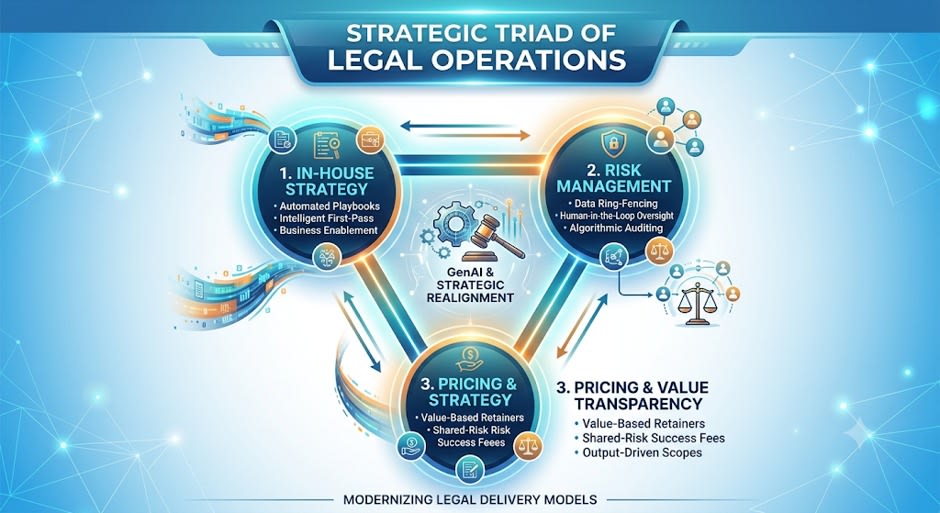
Transforming modern legal operations is no longer simply about purchasing software. It requires in-house legal departments and their external advisory networks to simultaneously overhaul strategic workforce planning, technical risk governance, and legal pricing architecture.
The Operational Realignment of In-House Legal Departments Legal operations leaders face relentless pressure to operate as proactive business enablers rather than reactive cost centres. Achieving this requires moving beyond basic matter management toward unified knowledge management and continuous automation.
Corporate legal teams are utilizing enterprise-grade large language models to re-engineer core legal tasks. In high-volume areas such as contract lifecycle management, compliance tracking, and first-pass employment counseling, generative systems function as intelligent digital associates. These platforms parse master services agreements against corporate playbook standards, redline non-standard clauses, and flag deviation risks before a human lawyer reviews the draft. This structural evolution changes the profile of corporate counsel. Instead of spending significant portions of their workweek conducting routine document review, corporate attorneys now focus on strategic risk mitigation, direct executive negotiation, and high-level corporate governance.
To maintain this leverage, in-house operations teams are establishing rigorous data foundations. Generative models require clean, categorized corporate precedent to produce reliable advice. Departments that systematically standardize historical agreements, litigation files, and board resolutions create proprietary operational knowledge that accelerates daily business transactions.
Navigating Regulatory and Technological Risk in Automated Ecosystems While the productivity benefits of automated workflows are substantial, the corresponding risk profile demands sophisticated technical and ethical controls. Corporate general counsel cannot compromise client confidentiality, legal privilege, or regulatory compliance to pursue raw operational speed.
Enterprise risk management within automated legal workflows centres on four critical pillars:
Data Confidentiality and Sovereign Isolation: Commercial public artificial intelligence tools carry severe data leakage risks. Enterprise legal operations must mandate zero-retention application programming interfaces, private cloud tenancy, and rigorous data ring-fencing. Corporate communications, intellectual property drafts, and sensitive litigation strategies must never be incorporated into external model training sets.
Privilege Protection and Work-Product Integrity: The legal application of automated generation introduces novel discovery challenges. In-house teams must ensure that prompts, data inputs, and system outputs remain protected under applicable attorney work-product and legal professional privilege doctrines, avoiding accidental subject-matter waiver during contentious litigation.
Mitigating Hallucinations via Retrieval-Augmented Generation: General models can generate factually incorrect citations or invent non-existent statutory provisions. To prevent these errors, modern legal architectures utilize retrieval-augmented generation. This approach anchors the language model directly to verified legal repositories, regulatory databases, and validated internal firm work product, strictly requiring traceable citations for every factual statement.
Human Oversight and Ethical Accountability: Complete end-to-end automation is inappropriate for high-stakes enterprise decisions. Operational frameworks must enforce a mandatory human review protocol. Legal professionals must retain direct responsibility for validating computational outputs, testing logic structures, and ensuring strict adherence to jurisdictional professional conduct rules.
Restructuring External Legal Partnerships and Law Firm Service Models As corporate legal departments build strong internal technological capabilities, external law firms must adapt their service models or face structural disintermediation. The traditional law firm pyramid, which depends on large cohorts of junior associates performing manual legal research and document review, is economically unsustainable in an automated market.
Forward-thinking law firms are proactively dismantling the billable hour in favour of transparent, value-oriented engagement models:
Engagement Model Operational Mechanism Risk and Value Alignment Fixed-Portfolio Pricing Flat recurring fees for predictable workflows like trademark maintenance or commercial leasing.
Shifts the efficiency incentive to the law firm, rewarding technology deployment and process speed.
Value-Based Retainers Tiered retainers tied to strategic business milestones, regulatory approvals, or closing velocity.
Aligns external advisory compensation directly with overarching corporate commercial outcomes.
Shared-Risk Arrangements Baseline operational rates combined with structured success fees for litigation victories or transaction execution.
Balances cost predictability for the client with upside margin opportunities for high-performing external counsel.
Law firms are also transforming into integrated legal technology and advisory providers. Rather than merely offering legal analysis, top firms build customized digital interfaces and private client portals. These platforms deploy fine-tuned legal intelligence models directly into client systems to resolve routine queries instantly, while reserving senior partner consultation for complex, non-standard enterprise exposure.
Integrating Strategy, Trust, and Commercial Viability The transformation of corporate legal operations requires a comprehensive realignment across technology, governance, and commercial models. Treating advanced artificial intelligence purely as a cost-reduction lever overlooks its strategic potential to elevate the corporate legal function into a resilient commercial partner.
Organizations that balance automated efficiency with uncompromising risk management and transparent pricing structures will establish durable strategic advantages, setting a new benchmark for professional legal excellence.
Share this article
Written by
Kaushik Karmakar
A legal industry expert and contributor to LexTalk World, sharing insights on global legal developments, technology, and professional growth.